
TLDR
The Muzeum Narodowe w Warszawie on Aleje Jerozolimskie is the country’s biggest art museum and a 12-minute walk from Twarda 52. The Polish-art gallery (Matejko, Boznańska, Wyspiański) is the headline. The Faras Gallery of medieval Christian Nubian frescoes is the surprise. Allow 2-3 hours, or 4 if you want the full collection. Adult ticket around 25 zł, free on Tuesdays. Closed Mondays.
Insider Tip
Go Tuesday morning when admission is free, but arrive at 10am for the opening, not at lunchtime. By midday on a free Tuesday the Polish galleries are uncomfortably busy. Two hours from opening you’ll have most rooms to yourself.
Planning your stay? Check current rates at Warszawa Centrum. A central, walkable base for exploring Warszawa.
What and Where the National Museum Is

The Muzeum Narodowe w Warszawie sits at Aleje Jerozolimskie 3, a 12-minute walk east of Twarda 52 or one stop on tram 7 from Centrum. The grand interwar building has been the country’s flagship art museum since 1938 and survived the war remarkably intact, many of the masterpieces inside are originals, not reconstructions.
Permanent collections cover Polish painting from the Middle Ages to the 20th century, European old masters, decorative arts, ancient Egyptian and Near Eastern artefacts, and the Faras Gallery of Christian Nubian wall paintings (the only collection of its kind in Europe).
Opening hours: Tuesday-Sunday, 10am to 6pm (Friday until 9pm). Closed Mondays. Adult ticket: around 25 zł for the permanent collection, free on Tuesdays. Special exhibitions cost extra (typically 30-45 zł).
The Polish Painting Gallery: The Headline
If you only have an hour, this is where to spend it. The Polish painting gallery on the upper floor is the country’s most important single collection, and most non-Polish visitors arrive without recognising any of the artists. That’s part of the visit.
Three names to know:
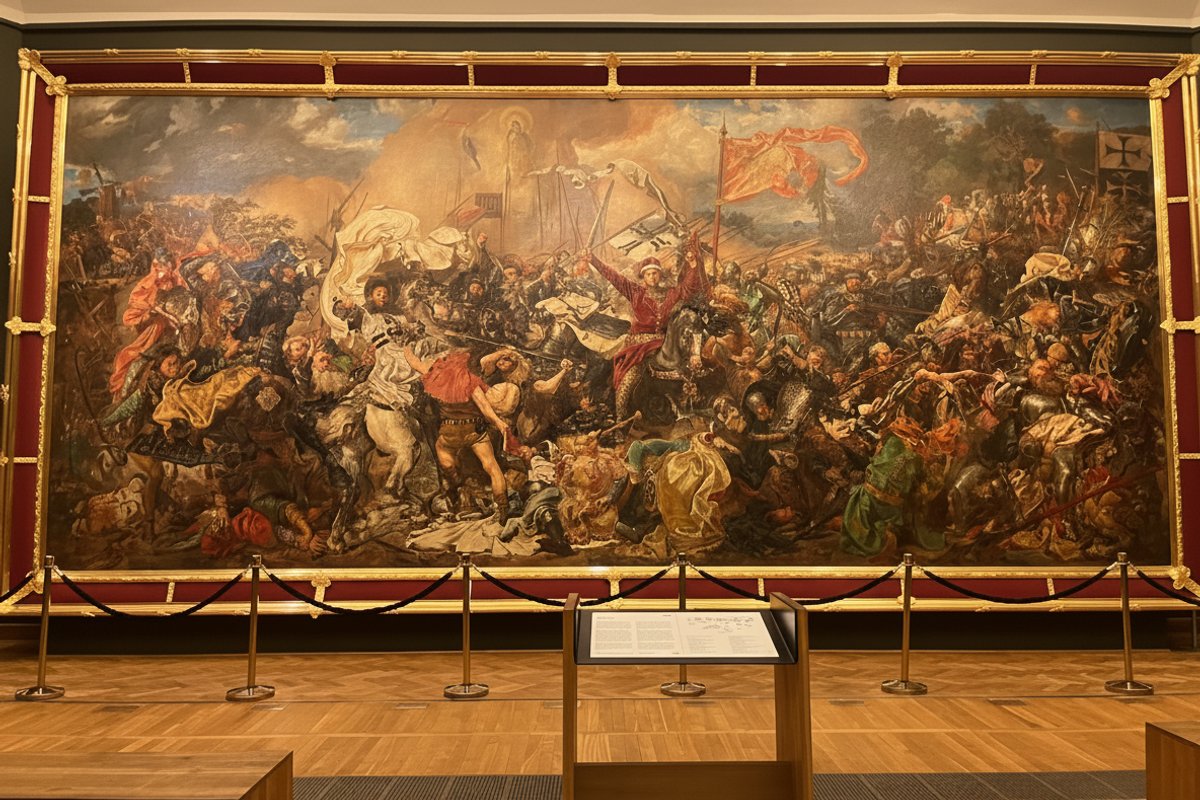
Jan Matejko, the 19th-century painter who codified how Poles see their own history. The Battle of Grunwald (the 1410 victory over the Teutonic Knights) is the museum’s most famous canvas, an enormous 4-metre by 9-metre wall painting that takes a full minute to absorb. It’s been called Poland’s national painting.
Olga Boznańska, late 19th and early 20th century portraits in muted, almost foggy palettes. The portrait of a girl with chrysanthemums is widely reproduced and worth seeing in person.
Stanisław Wyspiański, pastel portraits and stained-glass-window designs from the Polish Art Nouveau movement (Młoda Polska). Quieter than Matejko but the colour work is unmistakable.
Allow 60-90 minutes for the Polish gallery alone if you want to read the labels.
The Faras Gallery: The Underrated Highlight
Probably the museum’s biggest surprise. The Faras Gallery contains around 70 Christian wall paintings from the 8th-14th centuries, recovered by Polish archaeologists from a flooded cathedral on the Sudan-Egypt border in the 1960s before the Aswan High Dam submerged the site.
It’s the only collection of medieval Nubian Christian art outside Sudan and the most complete in Europe. Soft greens, ochres and earth reds, with calm, large-eyed saints staring out from carefully reconstructed wall fragments.
Tucked away on the lower floor, many visitors miss it entirely. Allow 30-45 minutes.

“Underrated for foreign visitors. The Faras Gallery alone is unique, medieval Christian frescoes from Sudan, beautifully presented. Then the Polish painting upstairs, including Matejko’s Grunwald. Easy half-day from Centrum.”
European Painting and the Old Masters
The European gallery is more modest than the Polish one but has genuine highlights. A small Rembrandt portrait, several Cranachs, a Botticelli Madonna, plus solid 17th-century Dutch and Flemish work. Worth 30-45 minutes if you’ve already done the Polish rooms.
Medieval and Renaissance Polish religious art occupies the rooms next door, gilded altarpieces from village churches, mostly anonymous artists. Atmospheric, less essential than the Polish painting gallery.
Ancient Egypt, Decorative Arts, and the Numismatic Cabinet
Ancient Egypt, small but well-displayed. Mummy cases, amulets, papyri.
Decorative arts, period-room reconstructions, porcelain, glass, silver. Less compelling unless you have specific interest.
Numismatic Cabinet, coins from the Polish-Lithuanian Commonwealth and beyond. For specialists.
Modern and contemporary Polish art, separate rooms covering 20th and 21st century work, including Witkacy and a small Tamara Łempicka. Worth 20-30 minutes.
Practical Visit Planning
How long to allow: 2-3 hours for the headline collections (Polish painting + Faras + European). 4-5 hours for the full museum including Egyptian, decorative arts and special exhibitions.
When to go: Tuesday morning at 10am opening for free admission and quiet rooms. Friday evening (open until 9pm) for a calmer visit after the day-tour rush.
What to skip if you’re short: the decorative arts wing, the special exhibitions (unless one specifically interests you), and the medieval Polish religious art (the Polish painting gallery is the better use of an hour).
Café and toilets: on-site café in the main lobby, modest but fine for a coffee break. Toilets clean and free with a museum ticket.
Audio guide: available in English and several other languages, around 10 zł. Worth it for the Polish painting gallery especially, most labels are bilingual but context adds a lot.
Pairing the Museum with the Rest of Your Day
Morning at the museum, lunch nearby. Walk south to Bar Mleczny Bambino on Krucza (5 minutes) for a cheap milk-bar lunch, or Hala Koszyki (15 minutes) for the food hall.
Afternoon: Łazienki Park. 25 minutes’ walk south of the museum, or three stops on tram 18. The Royal Łazienki gardens, the Chopin monument, and on Sundays in summer the free outdoor piano concerts at noon and 4pm.
Or pair with the Old Town. 25 minutes’ walk north from the museum via Krakowskie Przedmieście, a pleasant route past Warsaw University and the Holy Cross Church (where Chopin’s heart is interred).
Evening: dinner back in Centrum or Plac Zbawiciela. Walking distance from the museum if you want to keep moving on foot.
Honest Caveats
Some galleries are dimly lit. Particularly the medieval Polish religious art and the Faras frescoes (for conservation reasons). Bring reading glasses if you need them.
Labels are bilingual but not always fluent in English. Some translations feel a bit clunky. The audio guide is more polished.
Tuesday is busy. Free admission means crowded rooms by 11am. Arrive at 10am or skip the free day.
Special exhibitions vary widely. Some are top-tier loans from major European collections; others are minor regional shows. Check the current programme before paying the extra ticket.
Don’t conflate this with the National Museum in Kraków. Different city, different museum, different collection. Both are worth visiting if you’re doing both cities.
“I liked my stay here. Great location, strong WiFi, kind and friendly staff.”
See What Warszawa Centrum Looks Like
We may earn a small commission if you book through this link.
Check current prices at Warszawa Centrum
Warszawa Centrum (Holiday Inn Warsaw City Centre) sits two blocks from the Palace of Culture and an 8-minute walk from Warszawa Centralna. A reliable base for everything on this list.
Check Available RoomsWe may earn a small commission if you book through this link. It doesn’t cost you anything extra.
Frequently Asked Questions
What is the National Museum in Warsaw famous for?
The Polish painting collection, particularly Jan Matejko’s Battle of Grunwald, one of the largest history paintings in Europe at 4m x 9m. The Faras Gallery of medieval Christian Nubian wall paintings is the unique highlight: the only collection of its kind in Europe, recovered from Sudan in the 1960s.
Is the National Museum in Warsaw worth visiting?
Yes. It’s the country’s most important art museum, with a strong Polish painting collection that most non-Polish visitors haven’t heard of, plus the Faras Nubian frescoes that are unique in Europe. Allow 2-3 hours for the headline collections, 4 hours for the full museum.
How much does the National Museum in Warsaw cost?
Adult ticket around 25 zł for the permanent collection. Free on Tuesdays. Special exhibitions cost extra (typically 30-45 zł). Audio guide adds around 10 zł and is worth it for the Polish painting gallery.
When is the National Museum in Warsaw free?
Tuesdays, admission to the permanent collection is free all day. Arrive at 10am opening for the calmest experience; by midday on a free Tuesday the Polish galleries get crowded. Special exhibitions still charge on free days.
How long should I spend at the National Museum?
2-3 hours for the headline collections (Polish painting gallery, Faras Gallery, European paintings). 4-5 hours for the full museum including the Egyptian, decorative arts and any current special exhibitions. Allow longer if you read all the labels.
Is the National Museum in Warsaw open on Mondays?
No. The museum is closed on Mondays year-round. Open Tuesday to Sunday, 10am-6pm, with Friday extended to 9pm. Plan around the Monday closure.
How do I get to the National Museum from central Warszawa?
It’s at Aleje Jerozolimskie 3, walking distance from most central hotels. From Twarda 52 it’s a 12-minute walk east. From the Palace of Culture it’s a 10-minute walk south-east. Tram 7 from Centrum stops directly outside.
What’s the difference between the National Museum in Warsaw and in Kraków?
Different museums, different collections. The Warsaw National Museum has the strongest Polish painting collection (Matejko, Boznańska, Wyspiański) plus the Faras Nubian frescoes. The Kraków National Museum is split across multiple sites and has a strong decorative arts and 20th-century focus, including the famous Lady with an Ermine by Leonardo. Both are worth visiting if you’re doing both cities.